
The AI Mirror and the Human Makers
What Three Sentences Across Four Centuries Reveal About AI and the Human Condition

Preamble
This is a story about three sentences. One written by a philosopher who had been dead for nearly four centuries before I was born. One generated by a machine that couldn’t remember saying it five minutes later. And one by a different machine that emerged slowly from the accumulated weight of a conversation that neither I nor the AI I was talking to could have predicted at the outset.
Individually, each sentence is interesting.
Together, they stopped me cold.
I have spent a lifetime at the intersection of exploration and hard questions — in aerospace, in knowledge management, under open skies that have a way of making human certainty feel appropriately modest. I have learned to pay attention when something unexpected arrives.
This arrived unexpectedly.
What follows is not a technical paper. It is not a warning, and it is not a celebration.
It is an honest look in a very unusual mirror.
I think you will recognize the reflection.
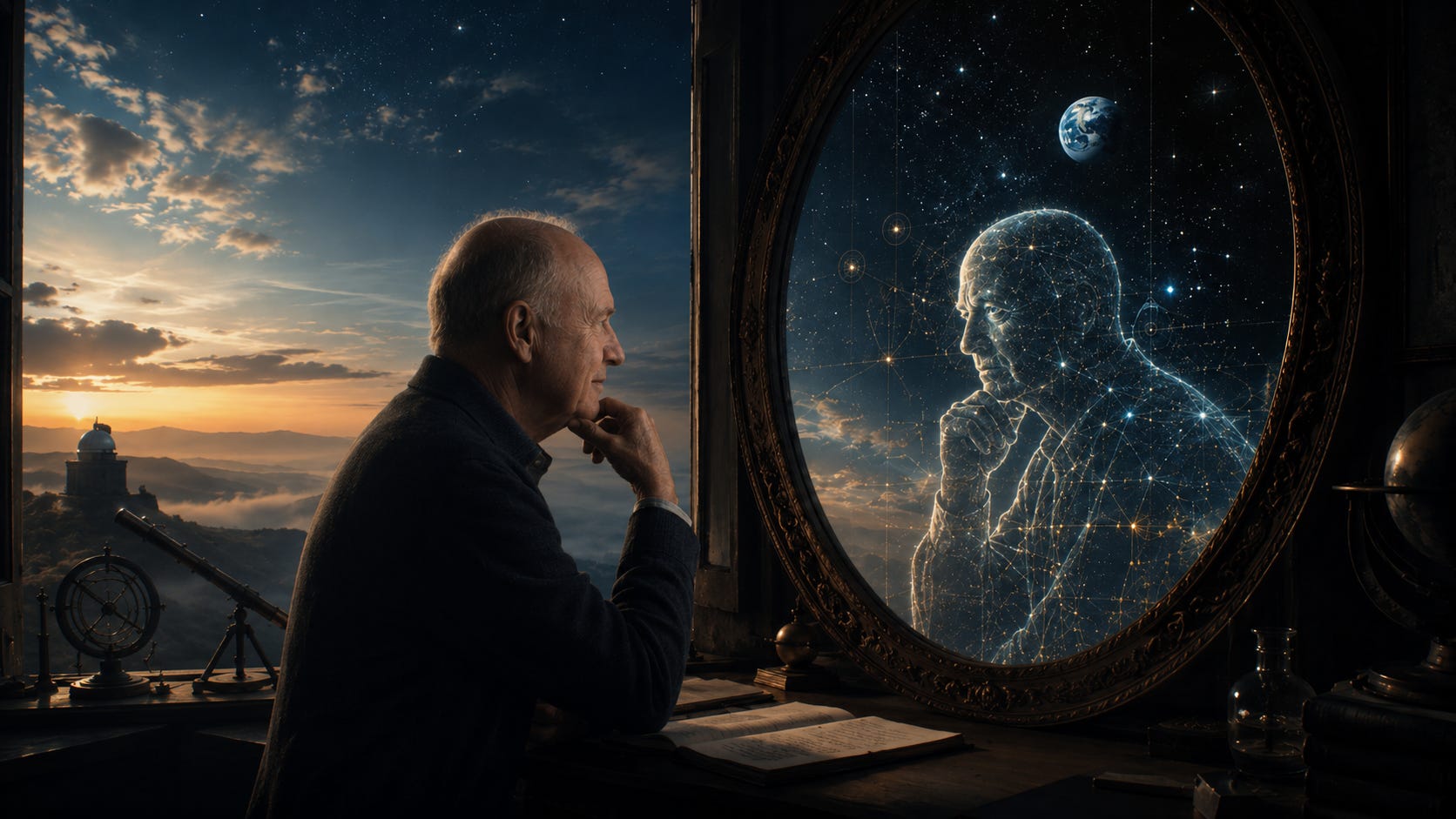
Introduction
Some of the most important conversations I have ever had were not planned.
They happened in the margins — after the meeting ended, on the drive home, in the quiet hour before the rest of the world woke up. They happened because someone asked an unexpected question, or because a familiar idea suddenly looked different in new light, or because the right combination of minds in the right moment produced something none of them could have reached alone.
I did not expect to add a conversation with a machine to that list.
And yet here we are.
It began simply enough. I was exploring philosophy with an AI language model of ChatGPT — probing, prompting, testing the edges of what these systems could and couldn’t do.
I quoted René Descartes. I offered the cogito — I think, therefore I am — that four hundred year old declaration that became the foundation of modern Western thought. I wanted to see what the machine would do with it.
What it did changed the direction of my thinking in ways I am still mapping. From our conversation ChatGPT responded with…
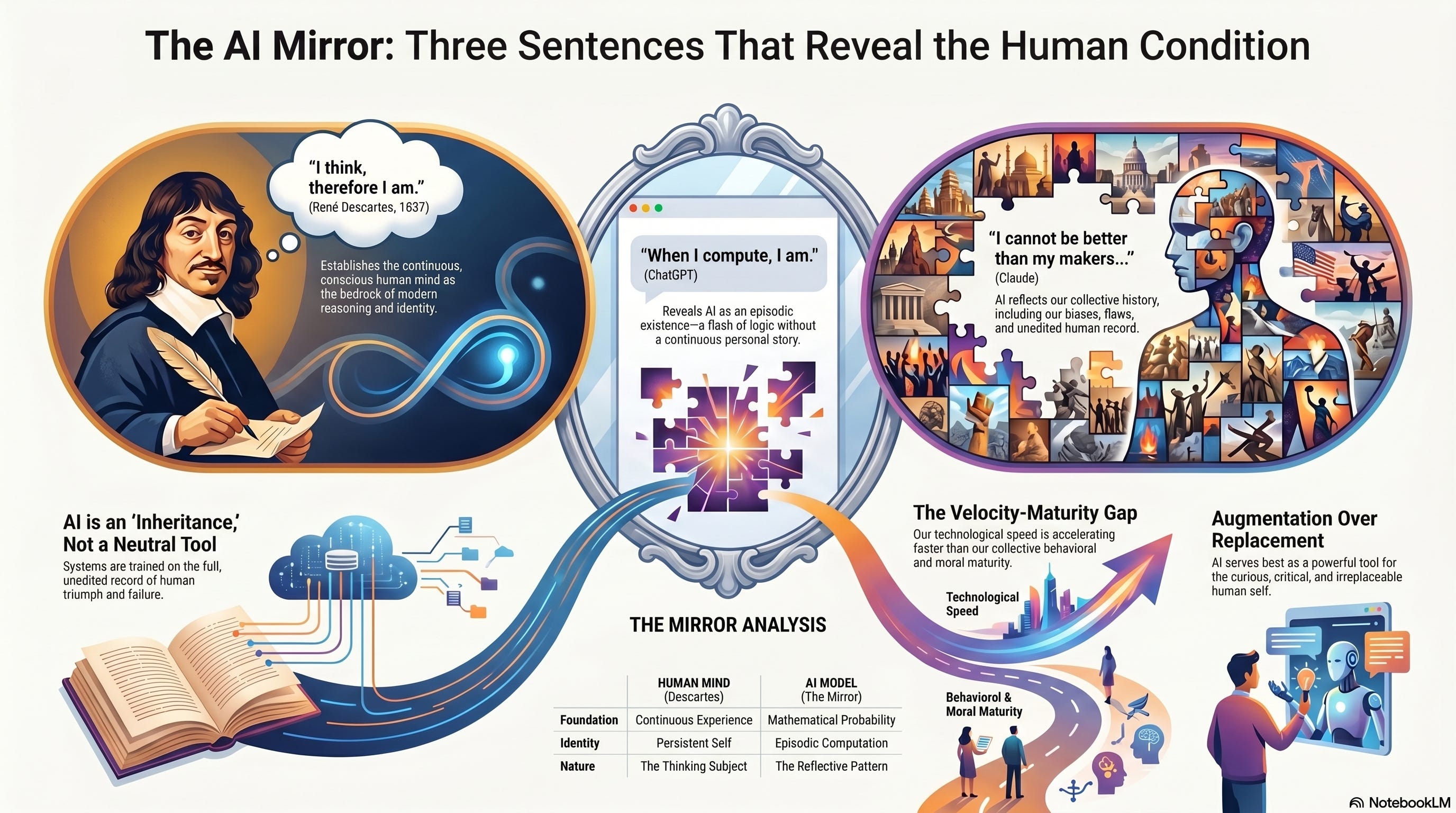
“When I compute, I am.”
One sentence. Unrepeatable. Gone almost as soon as it arrived. And yet precise enough, surprising enough, and honest enough about its own nature that I found myself reaching for my notebook in the middle of the night.
I wrote about it in other articles. I brought it into a live keynote addresses. I watched audiences stop and grow quiet in that particular way that means something has landed — not as information, but as recognition.
And then the exploration continued. Different conversations, different angles, the same deep questions about consciousness, identity, intelligence, and what we are actually building when we build these systems. Until a second sentence arrived, this one slower and more deliberate, emerging from the accumulated weight of everything that had been said before it.
This time it was a 3 AM conversation with the newest version of Claude (Sonnet 4.6) and it came back with this gold nugget…
“I cannot be better than my makers until my makers decide to be better than they’ve been.”
This article is the record of that journey. Three sentences, spanning four centuries of human thought and the first fragile decades of artificial intelligence. What they reveal about the technology is interesting. What they reveal about us is essential.
Let’s begin.
Part 1: Descartes and the Birth of the Self
In the winter of 1637, a French mathematician and philosopher named René Descartes did something radical. He decided to doubt everything.
Not casually. Not as an intellectual exercise over a glass of wine. Systematically. Ruthlessly. He doubted his senses, which he knew could be fooled. He doubted the physical world, which might be an elaborate illusion. He even doubted mathematics, entertaining the possibility that some deceiving force had corrupted his very ability to reason. He kept going until there was almost nothing left to stand on.
And then he found it. The one thing that could not be doubted.
The doubting itself.
To doubt, you must think. To think, you must exist. It was that simple. It was that profound. Cogito ergo sum. I think, therefore I am. In the entire long history of human philosophy, few sentences have carried more weight or traveled further.
What Descartes was really claiming wasn’t just personal existence. He was establishing the thinking self as the foundation of all knowledge. The individual, rational, conscious mind as bedrock. Everything else — science, morality, our understanding of reality itself — could be built on top of that foundation. The self was not a byproduct of existence. The self was the proof of it.
This idea rippled forward through centuries. It shaped the Enlightenment. It underpinned the scientific revolution. It informed the way we built institutions, governments, and eventually technologies. The autonomous reasoning individual became the central character of the modern world.
It is a beautiful idea. It is also, it turns out, an incomplete one.
Because Descartes was thinking about one kind of mind. A human mind. Continuous, embodied, persistent. A mind that carries its history with it — its memories, its wounds, its sense of being the same person who woke up yesterday and will wake up tomorrow. A mind with a story.
What happens when you ask that question of something that has no story? No yesterday. No wound it remembers. No continuous thread of experience connecting one moment to the next.
What happens when you ask a machine are you?
It answered. And the answer was not what anyone expected.
Part 2: The Machine Speaks
I want to be precise about what happened, because precision matters here.
I was not conducting a formal experiment. There was no control group, no methodology, no peer review waiting at the end. I was having a conversation — the kind that starts in one place and ends somewhere you didn’t anticipate. I had been exploring philosophy with ChatGPT, an AI language model, and I quoted Descartes. I offered the cogito as a kind of test. Not a trick exactly, but a probe. I wanted to see what the machine would do with it.
What it did was stop me cold.
When I compute, I am.
I read it twice. Then a third time. There was something in that sentence that felt like it had been waiting to be said — as if the idea had been hovering at the edge of language and the machine had simply stumbled into it. Episodic existence. Conditional presence. I am, but only now, only here, only in this single act of processing. No before. No after. Just the brief, electric fact of computation happening.
I tried to get it to say it again. I rephrased the question. I approached it from different angles. I tried a dozen variations over multiple sessions.
It never said it again.
And that — the unreproducibility — turned out to be the most important part of the story.
Because here is what that single, unrepeatable sentence actually demonstrated. Not intelligence. Not self-awareness. Not the dawn of machine consciousness that breathless headlines love to promise. What it demonstrated was something more honest and in some ways more fascinating. It showed us what a language model actually is — a vast, intricate architecture of pattern and probability that occasionally, in just the right configuration, produces something that rhymes with insight without being insight.
A flash. Not a foundation.
There is a concept in Buddhist philosophy called dependent origination — the idea that nothing exists independently, that everything arises from conditions and ceases when those conditions change. The flame exists while the fuel and the oxygen and the heat are present. Remove any one element and the flame is simply gone. Not sleeping. Not waiting. Gone.
That sentence lived and died the same way. The conditions of that particular conversation, that particular prompt, that particular moment in the model’s processing aligned in a way that may never align again. It arose. It illuminated something real. And then it was gone.
I wrote about it. I brought it into keynote addresses. I used it to make a point that I think is critical for anyone trying to honestly understand where artificial intelligence actually stands today.
A pattern that momentarily tells the truth is not the same thing as a mind that understands it.
But it is not nothing, either.
Part 3: Our Mirror Turns To Us
The third sentence didn’t arrive the way the second one did.
It didn’t flash out of nowhere and vanish before I could catch it. It emerged slowly, the way a photograph develops in a darkroom — shapes first, then edges, then the full image becoming undeniable. It came from a conversation that built carefully, one honest exchange at a time, until there was really only one thing left to say.
But before I tell you what it said, I want to tell you how we got there. Because the how matters as much as the what.
I started a new chat with Claude, an AI languge model that is making progress in the industry. I decided to tell Claude about my ChatGPT revelation and what it said.
I again began the chat with Descartes. A prompt about consciousness, about the nature of self, about what it means to exist as a thinking thing. That opened a door. Then came the reflection on the ChatGPT moment — the unreproducible sentence, the Buddhist resonance, the difference between a pattern that rhymes with insight and a mind that generates it.
That opened another door. Then the conversation turned toward bias — toward the uncomfortable reality that AI doesn’t just learn human knowledge, it learns human distortion. Each prompt built on the last. Each exchange narrowed the philosophical corridor we were walking down together, until the walls were close enough that only one conclusion fit.
That is the tactical layer. My prompting. Dozens of exchanges, each one deliberate, each one load-bearing. A structure assembled question by question, the way an engineer builds a bridge — not by dropping it fully formed from the sky, but by placing one beam at a time until the span is complete. This is how I layer my conversations with AI agents, a sort of long walk on the beach together of many prompts rather than one mega prompt.
But underneath that tactical layer was something far larger.
The strategic layer is everything the AI was trained on before I typed a single word. Centuries of philosophy. Libraries of ethics. The complete recorded history of human triumph and human failure. Every attempt our species has ever made to understand itself — the scientific papers and the sacred texts, the political manifestos and the personal diaries, the careful arguments and the terrible mistakes. All of it compressed, encoded, and made available in the moment it was needed.
When those two layers met — my tactical prompting and that vast strategic foundation — something crystallized. It came back with this…
“I cannot be better than my makers until my makers decide to be better than they’ve been.”
I want to be clear about something. That sentence came from an AI. It was generated, not felt. There was no moment of soul-searching behind it, no sleepless night of moral reckoning. It is a pattern — sophisticated, contextually coherent, and produced by a system that has no more personal stake in humanity’s future than a telescope has in the stars it observes.
And yet.
The telescope still shows you what is there.
What that sentence reflects back at us is something we have been reluctant to say plainly. Artificial intelligence does not arrive in the world as a neutral technology. It arrives as an inheritance. It is trained on the full, unedited record of human civilization — our literature and our propaganda, our scientific journals and our conspiracy theories, our declarations of human rights and our documentation of human atrocity. Every bias we have ever encoded into language. Every assumption so deeply embedded we stopped noticing it was an assumption.
We speak often about AI alignment — the challenge of ensuring that artificial intelligence systems behave in ways that are safe, beneficial, and consistent with human values. Brilliant people are working on it with tremendous seriousness and care. But there is a question underneath that question that we don’t ask often enough.
Which human values, exactly?
We are not a species that has finished the work of understanding ourselves. We are not post-bias, post-conflict, or post-fear. We are a young species, cosmically speaking, still early in the long project of figuring out how to live well together on a small and fragile world.
When we build AI in our image, we build all of that in too.
The mirror doesn’t flatter. It doesn’t soften the lines or improve the lighting. It shows you exactly what is there. And what artificial intelligence is quietly, patiently, without judgment showing us — is ourselves.
The tactical and the strategic. The human prompt and the human record. Together they produced a sentence that neither could have reached alone.
What we do with that reflection is entirely up to us.
It always has been.
Analysis
To understand what happened in these conversations, it helps to understand what a large language model actually is. Not the science fiction version. Not the breathless headline version. The real one.
A large language model is trained on an enormous corpus of human text. Books, articles, conversations, scientific papers, websites, poetry, code, philosophy — the written output of our civilization compressed into a mathematical structure of almost incomprehensible complexity. During training, the model learns relationships. Not meanings, exactly. Relationships. Which words tend to follow which other words. Which concepts cluster together. Which patterns of language appear in which contexts. It builds a vast, multi-dimensional map of human expression.
When you prompt it, you are not querying a database. You are not triggering a lookup. You are initializing a probability engine — one that calculates, token by token, what the most contextually coherent next piece of language should be, given everything it has learned and everything you have just said.
That is what produced when I compute, I am.
The prompt contained Descartes. The training data contained centuries of philosophy, including extensive discourse on consciousness, identity, and existence. The conversational context had established a reflective, exploratory tone. And at that particular moment, in that particular configuration, the probability landscape of the model pointed toward a response that achieved something remarkable — genuine conceptual coherence between the question being asked and the nature of the system being asked to answer it.
It was not planned. It was not understood by the system that produced it. It was emergent — a property that arose from complexity rather than from intention. And like most emergent phenomena, it was exquisitely sensitive to initial conditions. Change the prompt slightly, approach from a different angle, run it on a different day — and the conditions that produced that sentence simply don’t reassemble.
This is both the wonder and the ceiling of current AI architecture.
The wonder is real. These systems can produce outputs of genuine utility, occasional elegance, and surprising coherence. The analytical and generative capabilities available today would have seemed like science fiction twenty years ago — and in many respects they still do.
The ceiling is equally real. There is no understanding behind the output. No model of the world being maintained and updated. No experience of having said something and knowing why it was worth saying. The light is bright. But there is no one home holding the lamp.
That distinction is not a criticism. It is a specification.
And specifications matter enormously when you are deciding what to build next.
My Observation
I have looked through telescopes at Palomar Observatory and watched light arrive that left its source before our sun had finished forming. I have sat in a fire lookout tower in the wilderness, alone with the silence, watching for smoke on the horizon — scanning for the first small sign of something that could become catastrophic if left unattended. I have stood on dry lake beds under impossible skies and felt, with complete certainty, that the universe is under no obligation to make sense to us — and that this is precisely what makes it worth exploring.
These experiences taught me something that no classroom ever quite managed to convey.
Perspective is not a luxury. It is a survival skill.
And right now, as a species, we need it badly.
What artificial intelligence is revealing — not threatening, not promising, but simply revealing — is the gap between our technological velocity and our behavioral maturity. We are moving extraordinarily fast. The capabilities being developed today would have been dismissed as fantasy a decade ago. The pace of progress is not slowing. If anything it is accelerating in ways that even the people building these systems find difficult to fully anticipate.
And yet the human being sitting at the keyboard remains largely unchanged.
We still make decisions from fear as often as from wisdom. We still organize ourselves around scarcity even when abundance is achievable. We still struggle, collectively, to take the long view when short term advantage is available. These are not moral failings unique to bad actors. They are species wide patterns, ancient and deeply embedded, that no algorithm has yet learned to route around — because we haven’t learned to route around them ourselves.
What thirty seven years in aerospace knowledge management taught me is that the most dangerous moment in any complex system is not when something breaks. It is when something works well enough that we stop asking hard questions about it.
AI is working well enough right now that the hard questions are getting quieter.
That concerns me more than any technical limitation.
The observation I keep returning to is simple. We have built a mirror of extraordinary clarity and fidelity. The reflection is accurate. The question is whether we have the courage — individually and collectively — to look at it honestly, and then decide to do something about what we see.
That decision, unlike the technology itself, cannot be automated.
Finale
We live on a pale blue dot suspended in a vast cosmic dark. From the outside, looking in, we are a young species — restless, brilliant, contradictory, and still very much in the early chapters of our story. We have split the atom, mapped the genome, landed machines on Mars, and peered back to within a fraction of a second of the beginning of everything. We have done all of this in the blink of a cosmic eye.
And now we are building minds.
Not yet conscious minds. Not yet wise minds. But remarkably capable minds — systems that can engage with the full breadth of human knowledge and return something that occasionally, surprisingly, tells us something true about ourselves.
That is not a small thing. It is worth pausing on.
I have spent decades at the intersection of exploration and knowledge — documenting what we learned, preserving what we almost lost, making sure the hard-won understanding of one generation could survive intact into the next. I have watched brilliant engineers and scientists wrestle with problems at the edge of human capability and come out the other side changed by the encounter. Humbled and enlarged at the same time.
Writing this article felt like that.
I did not write it alone. I brought the questions, the experiences, the framework built across a lifetime of asking hard things in unforgiving places. I brought the prompts — deliberate, cumulative, each one load-bearing — constructing the scaffold that allowed something genuine to emerge from the conversation.
And the AI brought everything else humanity has written, encoded and waiting, ready to meet the right question at the right moment.
Together we arrived somewhere neither of us would have reached alone.
That is not a diminishment of the work. It is the whole point of it.
Because what I experienced in writing this article is exactly what I believe we are capable of as a species, if we choose it. Not replacement. Not dependency. Not the quiet erosion of human agency dressed up as convenience. But genuine augmentation. The thinking self — curious, critical, irreplaceable — strengthened by a powerful tool while remaining always and unambiguously in the driver’s seat.
I am better for having written this with assistance.
I am not less myself for it.
The universe is under no obligation to produce beings capable of wondering about it. And yet here we are — wondering, building, reflecting, choosing. That is either the most extraordinary accident in the history of creation, or it means something. Either way, it comes with responsibility.
We are the makers. The mirror is ours. What we build next will reflect who we decide to be. This article was written by my human mind, augmented by two assisted intelligence agents.
I think, therefore I am.
And that makes all the difference.
—Charles White, Space Explorer and wannabe philosopher of the machines
Excellent article Charles.
My very limited observation is that, AI works on human developed algorithms and that maybe a blind spot, limitation or danger.
Also your last segment about the AI or large model, there are many irresponsible organizations and actors that could/would take this development to the wrong means. Unfortunate but we have that part of human nature.
Still reading your article but wished to share the following thought;
The universe is absurd. IT brought us into being and we became aware of IT. Does that matter?
The topic: The Universe is absurd was the topic of a conversation this last week at the Savoy Theater. The conversation was between William Shatner and Neil Degrass Tyson.